
How Do I Know If My Antidepressant Is Working? Signs of Progress to Look For
By Joseph Han, PMHNP
You've been taking an antidepressant every day for a few weeks, but nothing dramatic has happened.
So you start wondering: Is this actually working?
Antidepressants don't usually work like an on-off switch. Improvement can happen gradually, and sometimes the first signs show up in what you're doing before you fully recognize a change in how you're feeling.
Instead of only asking, "Do I feel better?" another useful question is:
"What has become easier for me compared with a few weeks ago?"
This article is for educational purposes only and is not a substitute for individualized medical advice. Always discuss questions about your treatment with your prescribing clinician.
Look at Functioning, Not Just Feelings
When evaluating whether an antidepressant may be helping, symptoms matter—but so does functioning.
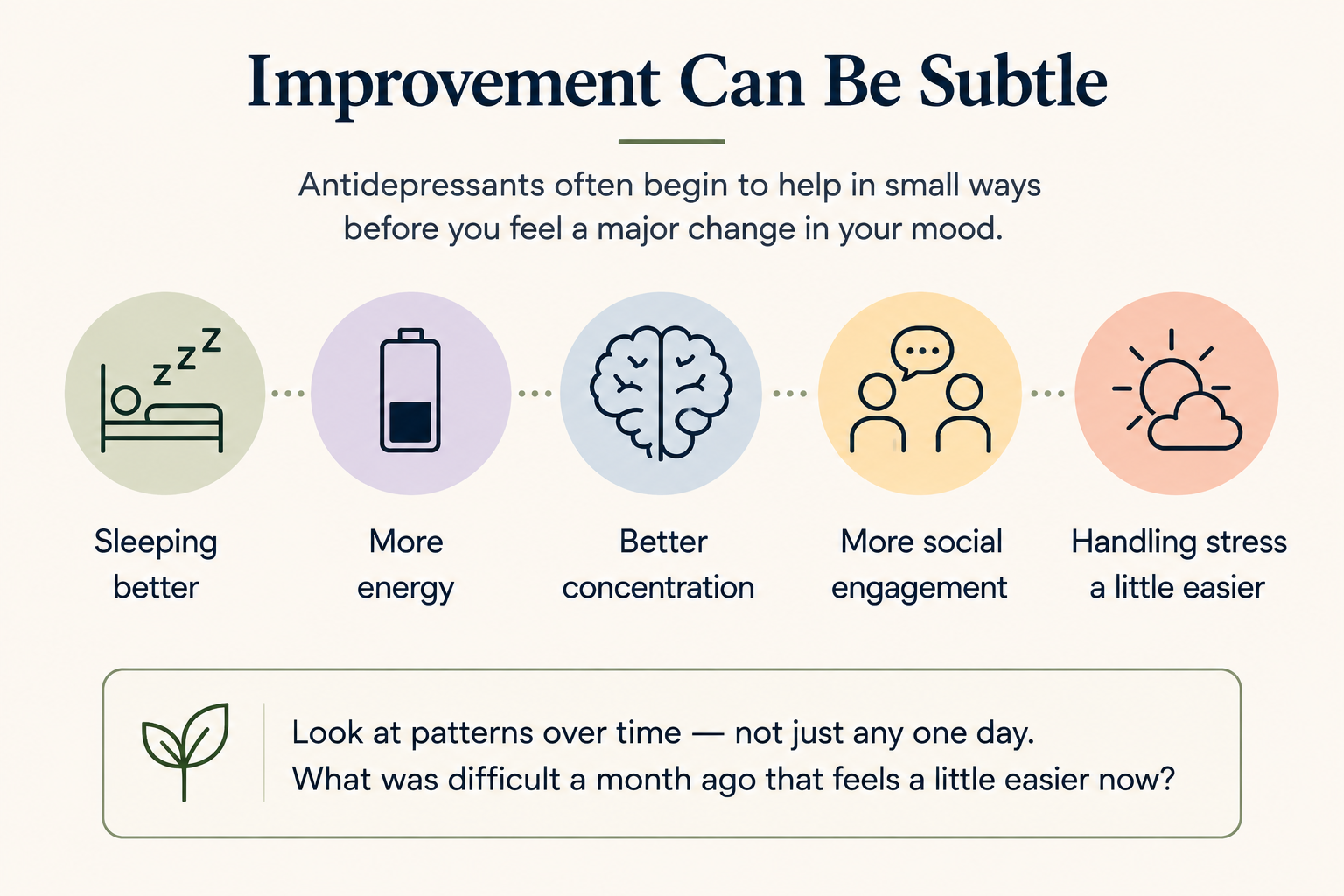
Are you sleeping better? Is it easier to get out of bed? Are you concentrating more effectively at work or school? Do you have more energy? Are you less irritable? Are you reconnecting with friends, hobbies, or activities you've been avoiding?
Imagine someone who says, "I don't really feel happier."
But a month ago, getting out of bed was difficult. Now they're getting to work, exercising again, answering friends' texts, and sleeping more consistently.
Those changes matter.
The goal of treatment for depression isn't to make someone happy all the time. Sadness, anxiety, disappointment, and stress are normal parts of life. Similarly, treatment for anxiety isn't intended to eliminate every experience of nervousness or worry. The question is whether symptoms are becoming less disruptive to your ability to live your everyday life.The question is whether symptoms are becoming less disruptive to your ability to live your everyday life.
Improvement Can Be Subtle
Sometimes other people notice changes before you do.
A partner might say, "You seem more like yourself." A friend may notice you're talking more. Your family may notice you're leaving the house again or participating in conversations differently.
For many people, "feeling more like yourself" means moving closer to how they were functioning before depression or anxiety began interfering with their lives.
That doesn't mean everything suddenly becomes easy. Medication can't eliminate a stressful job, repair a difficult relationship, or remove grief or hardship. Life circumstances still matter.
And progress doesn't move in a perfectly straight line. You can have a bad week while treatment is generally helping—or a good week while you're still struggling.
That's why patterns over time usually tell us more than any single day.
Rather than checking every morning to see whether you "feel different," try looking backward occasionally:
What was difficult for me a month ago that feels a little easier now?
What If I'm Better—but Only Partly Better?
Treatment isn't always either "working" or "not working."
Sometimes the answer is simply: It's helping, but there's still room for improvement.
At follow-up, a provider may consider what's improved, what's still interfering with your life, how long you've taken the medication, the dose, side effects, missed doses, other health conditions, therapy, and what's happening in your life outside of medication.
There isn't one automatic next step.
Sometimes continuing the current plan makes sense. Sometimes a dose adjustment may be considered. In other situations, a different medication or treatment strategy may eventually make more sense.
The goal is to find the best overall balance of benefit, side effects, safety, and what matters to you.
If you've only recently started an antidepressant, you may also find it helpful to read about what to expect during the first few weeks of an SSRI or SNRI.
Medication Can Help Get the Ball Rolling
Medication isn't supposed to do all of the work.
Someone with social anxiety may still feel nervous talking to people—but perhaps the anxiety becomes manageable enough to start practicing those conversations.
Someone with depression may not suddenly want to exercise—but perhaps they have enough energy to go for a walk.
Or therapy may still involve difficult emotions, but those emotions become easier to work with without feeling as overwhelmed.
Sometimes psychiatric medication management and psychotherapy-informed care can work together, creating enough room for the other parts of treatment to start moving too.
What If It's Been a Few Weeks and I'm Not Feeling Better Yet?
Don't automatically assume the medication has failed.
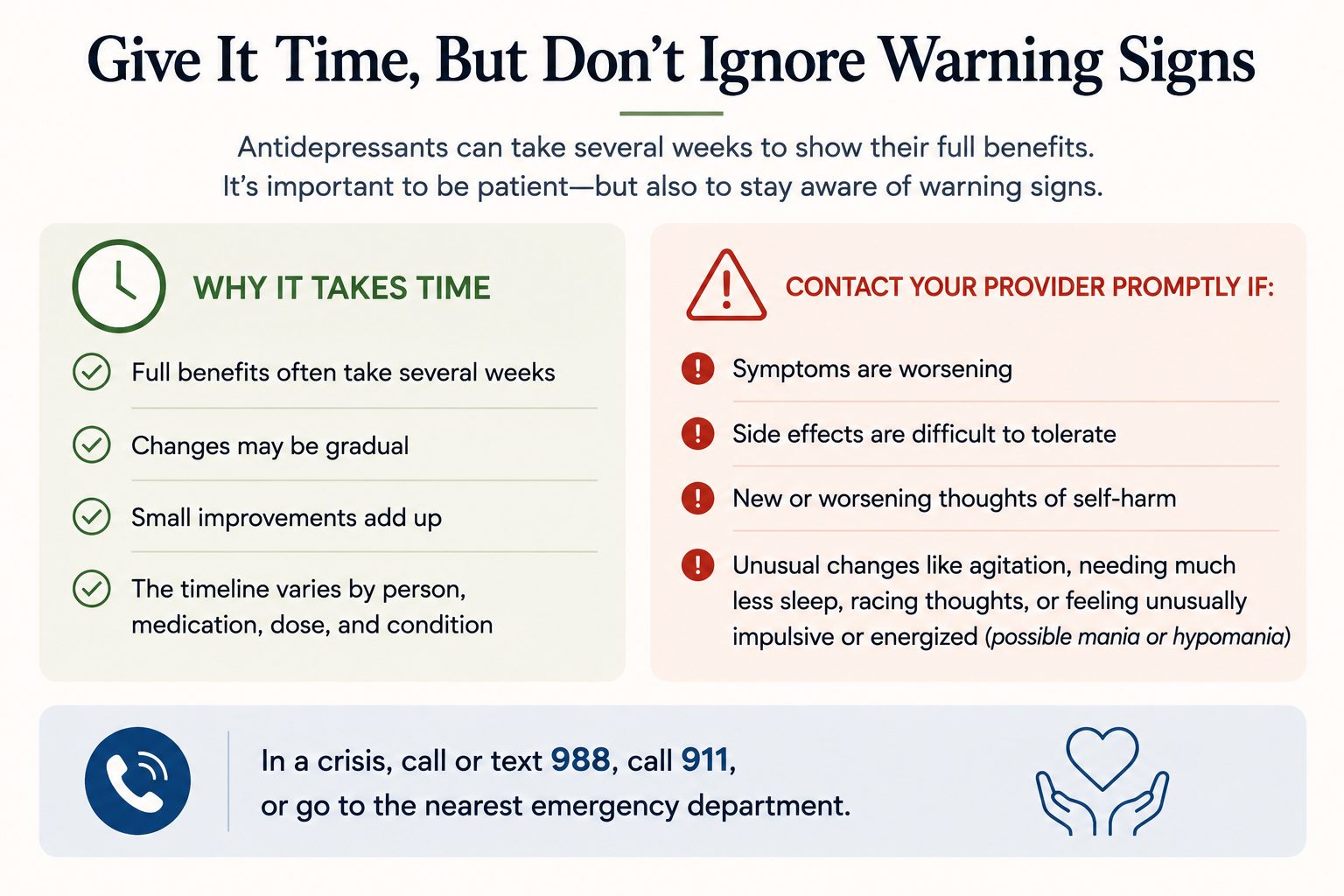
Antidepressants often require several weeks before their fuller benefits become apparent, and the timeline varies by medication, dose, condition, and individual.
It can be helpful to check in on your progress weekly rather than judging the medication day by day. Pay attention to things like your sleep, energy, mood, anxiety, concentration, daily functioning, social engagement, and side effects. Those observations can make your follow-up appointment much more useful.
At the same time, giving medication time does not mean ignoring problems.
Do not stop, skip, or change your medication dose on your own because you're discouraged or experiencing side effects. Contact your prescribing clinician so you can decide together on the safest next step.
Contact your clinician promptly if symptoms are worsening, side effects are difficult to tolerate, or you notice an unusual change in mood or behavior—such as marked agitation, needing much less sleep than usual, racing thoughts, or feeling unusually impulsive or energized. These types of symptoms can sometimes occur with mania or hypomania and warrant prompt evaluation.
New or worsening thoughts of self-harm also require prompt attention. If you are in immediate danger, think you may act on thoughts of harming yourself or someone else, or cannot keep yourself safe, call or text 988 in the United States, call 911, or go to the nearest emergency department.
Progress Does Not Have to Feel Dramatic
When people imagine an antidepressant "working," they sometimes expect to suddenly feel completely different.
Often, progress is quieter than that.
Things that required enormous effort may begin requiring a little less. You may sleep better, engage more with other people, have more energy for therapy, or start participating in your life again.
Those small changes can add up.
So rather than waiting for one dramatic moment when the medication suddenly "kicks in," pay attention to the direction you're moving.
What can you do today that was harder for you a month ago?
That answer may be one of the most useful things you bring to your next appointment.
About This Practice
Joseph Han, PMHNP, provides psychiatric evaluation and medication management for adults located in New York State. Treatment is individualized based on symptoms, functioning, goals, preferences, and the broader circumstances affecting each person's mental health.
If you're considering psychiatric medication management and would like to learn more about services and scheduling, book an introductory call here. Introductory calls are for general practice and scheduling information and do not provide diagnosis, treatment, medication advice, or crisis services.
This article is intended for educational purposes only and does not establish a provider-patient relationship. It should not be used as a substitute for individualized medical advice, diagnosis, or treatment. If you are experiencing a mental health crisis, call or text 988 or seek emergency care.