
Starting Psychiatric Medication: What to Expect (A Beginner’s Guide)
By: Joseph J. Han, PMHNP
Deciding whether to start psychiatric medication is rarely simple. Common questions include: Do I actually need this? Will it change who I am? What if it doesn't work? Does needing medication mean something is wrong with me?
These questions are not a sign of weakness. They're a sign of taking mental health seriously — and they deserve real answers, not marketing language in either direction. Psychiatric medication is sometimes portrayed as a cure-all and sometimes dismissed as something only for "severe" cases. Neither framing is accurate.
This article won't tell you whether medication is right for you — that's a decision made with a licensed provider who knows your history. What it can do is offer a clearer starting point for that conversation.
This article is for general educational purposes only and is not a substitute for individualized medical advice, diagnosis, or treatment. Always consult a licensed healthcare provider about your specific situation.
Medication Doesn't Erase Life's Challenges — That's Not the Goal
A common misconception is that psychiatric medication is meant to eliminate stress, sadness, or difficulty altogether. It isn't. Grief, disappointment, and uncertainty are part of being human, and no medication is designed to remove them.
What medication may help with is reducing symptoms that have started to interfere with daily functioning — for example, when depression makes it hard to get out of bed, when anxiety limits what feels manageable, or when attention difficulties make it hard to follow through despite real effort.
The aim isn't a symptom-free life. It's fewer barriers between you and the life you're trying to live.

Functioning Matters as Much as Symptoms
Treatment decisions aren't based on symptom checklists alone. A central question providers consider is how symptoms are affecting day-to-day functioning — work, relationships, sleep, motivation, self-care, and the ability to engage in therapy.
Two people can report similar symptoms and still need very different treatment plans, because those symptoms aren't affecting their lives in the same way. This is part of why psychiatric care should be individualized rather than formulaic, and why an in-person evaluation is necessary before any treatment decision is made.
Medication Is One Option Among Several
Psychiatric medication is one evidence-based tool, not the only one. Depending on the situation, a treatment plan may combine medication with psychotherapy, sleep and lifestyle changes, stress management, or addressing underlying medical conditions that affect mental health. Medication doesn't replace therapy, and therapy doesn't automatically remove the need for medication. The right combination varies by person, and it's determined collaboratively — not prescribed unilaterally.
Weighing Benefits Against Side Effects
Every medication carries potential side effects, and that's worth naming honestly. At the same time, side effects are only half of the equation. Treatment decisions involve weighing the potential benefits — reduced symptoms, improved functioning, more capacity to engage in life and in therapy — against the potential risks, including side effects, on a case-by-case basis.
This isn't a reason to fear medication, and it isn't a reason to dismiss the risks either. It's a conversation to have directly with a prescriber: what side effects are possible, how likely they are, how they're monitored, and what the plan is if they occur. A good provider will walk through this with you rather than leaving you to research it alone.
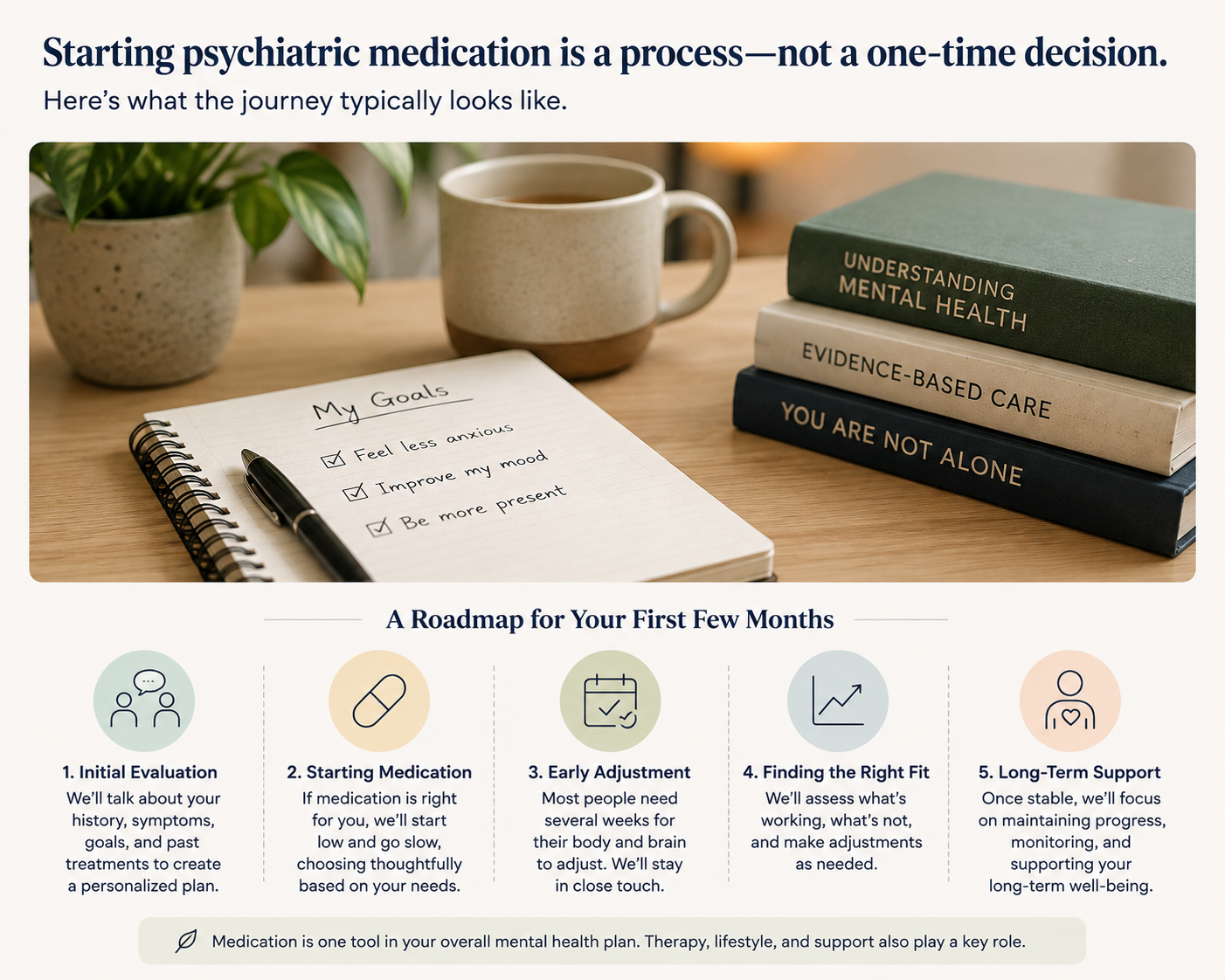
Starting Medication Is a Beginning, Not a Finish Line
Many psychiatric medications take several weeks to reach their full effect, and that timeline is often longer than people expect. It's common to notice mild side effects early on that ease with time, and it's also common to need a dose adjustment or a change in medication before finding the right fit.
This process doesn't mean something has gone wrong. It reflects how individualized medication response actually is — and it's exactly why follow-up appointments matter as much as the initial prescription. Treatment that seems to be "not working" after a few days is not yet a failed treatment; it may simply need more time or a small adjustment, and that's a conversation for a follow-up visit, not a reason to stop on your own.
Will Medication Change Who You Are?
Most people starting medication aren't hoping to become someone else — they're hoping to become a better version of who they already are: clearer-headed, more present, more able to do the things they've wanted to do.
That's the actual goal of treatment.
If treatment is not working toward that goal and does the opposite, it’s a signal to talk to your provider. Your provider can collaborate with you to adjust treatment to move you toward the right direction.
Progression, Not Perfection
Mental health treatment is rarely a single fix. It's a process that may involve adjustment over time, and it looks different for everyone. For some, medication creates enough stability to make therapy more effective. For others, therapy builds the skills that make lasting change possible, while medication reduces the intensity of symptoms in the meantime.
The goal isn't a perfect outcome. It's steady, meaningful progress toward the life you're trying to build.
Talking to Your Provider
Walk into that first appointment with real questions: What benefits can I expect, and how long might they take? What side effects are most common, and how are they monitored? What happens if this doesn't work? How does this fit with therapy or other parts of my care?
Whether medication becomes part of your treatment plan is a decision made collaboratively with a licensed provider, based on your history, goals, and an individualized evaluation — not a blog post. The more informed you are going in, the more productive that conversation is likely to be.
About This Practice
Joseph Han, PMHNP, provides psychiatric evaluation and medication management for adults across New York State, including New York City (Manhattan, Brooklyn, Queens, Bronx, and Staten Island). Every treatment plan starts with a thorough, individualized evaluation — not a one-size-fits-all prescription.
If you're considering medication and want to talk through your options with a licensed provider, click here to book an intro call.
This content is for educational purposes only and does not constitute medical advice or establish a provider-patient relationship. If you are experiencing a mental health crisis, contact 988 (Suicide & Crisis Lifeline) or seek emergency care.